

By Craig Hutchinson
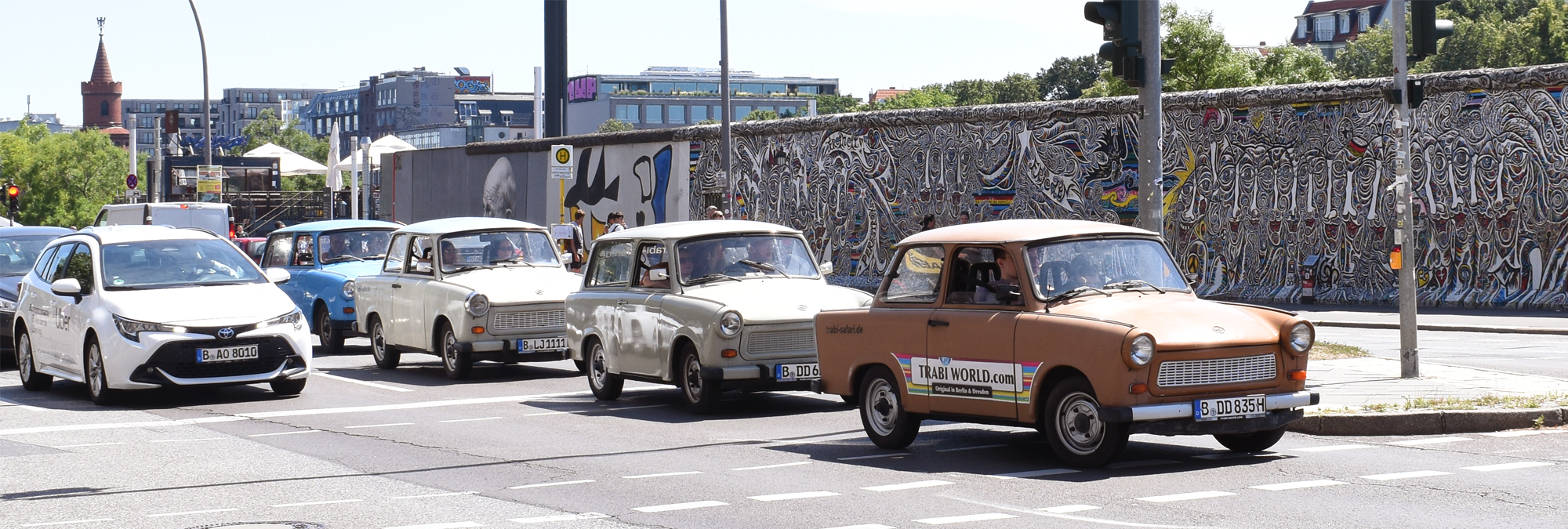
Thomas Schmidt’s parents ordered a Trabi in 1973, their wait shortened because they were newlyweds. 15 years later, in 1988, the car finally arrived, and Schmidt posed next to it for a picture. Today, a car like it sits outside Trabi World, where Schmidt works as a freelance tour guide leading visitors through Berlin in a line of the same East German vehicles he grew up with.
Lovingly called the “Trabi,” the Trabant, is a small East German car manufactured from 1957 to 1991.
“I like East cars very much,” he said. “I have a special experience with this car. This is exactly what I want to have.” For Schmidt, the wait wasn’t unusual. It was just what life in the German Democratic Republic (DDR) looked like from the inside.

The Split
Through 1946 and 1947, relations between the United States of America and the Soviet Union began to deteriorate as each country fought to establish their influence in postwar Europe. In the wake of WWII, the plan was to de-nazify Germany and allow them to return to sovereignty, until the tensions began. As the 1940s continued, America’s foreign policy became dedicated to stopping the spread of communism, whereas the Soviets encouraged nations to adopt communism by sending various forms of aid. In 1952, movement between East Germany and West Germany became restricted when East Germans introduced a system of passes for visits of West Berlin residents to the territory of East Berlin. Then in 1961 the Soviets pursued the construction of the Berlin Wall to further restrict the movement of its civilians and to protect the integrity of communism from the influences of the western world.

Normal Life
Within the restrictions imposed by the government, East Germans didn’t always experience their country as another dictatorship. It was possible to live a normal life in the DDR, so long as you avoided trouble with the government. “Unemployment didn’t exist, homelessness didn’t exist,” said Liza Soutschek, curator of the DDR Museum, “The state cared for you a lot.”
This care manifested itself beyond the livelihood of its citizens. The SEZ building, once a public swimming and leisure complex in East Berlin that opened in 1981, still stands behind a fence, walls covered in graffiti. Soutschek said it’s beyond saving, structurally unsound at this point with no real path

back, but it’s not remembered for what it’s become. Countless East Berliners spent their childhoods there, in a facility that offered a place to swim, bowl, skate and be with other people.
Schmidt’s experiences
For Schmidt, a freelancing tour guide at the Trabi World, life in the DDR was not the dictatorship the history books made it out to be. “You grew up like every normal child,” he said. “You think your life is normal because you don’t know what was on the other side. Everybody grows up like me, so this is a normal life.”
Part of that normalcy was access to opportunities to explore his interests. Whatever he wanted to try, from sports to radio training, was available to him. “I see today that for younger people in West Germany, you have no money, and they sit on the streets, they don’t know what they should do,” he said. “This was much better in the east.” It’s a comparison he’s still making in the present and part of what he misses most, watching kids today without the same access he had.

Struggles with reunification
With German reunification in 1990, western Germany effectively took over the former communist territory. Many former East Germans lost their jobs, therefore needing to sell their properties to survive as West Germans came over and bought properties for at bargain prices. The DDR system that structured the lives of East Germans effectively disappeared overnight. “There were a lot of shortages and different ways of dealing with shopping. Prices would be set by the government,” Katherine Pence, associate professor of history at Baruch College, said. “East Germans would have to work out how to get what they needed. All of that was gone when the wall fell.”
Small things marked this difference too. Bananas became an unlikely symbol of reunification, a fruit that had been scarce in the East and once available, took on an outsized meaning. But the novelty didn’t last. “Easterners were attracted to the things the West had, but once they got it, it tripped them up,” Pence said. It “made them feel like second-class citizens in their own country.”
Schmidt experienced these changes firsthand. Himself, his father, and his schoolmates all faced unemployment as the wall came down. As a child, Schmidt was in a Junge Funker group that taught him electronics and radio technology, learning morse code to eventually work in a military radio position. But when the wall fell, he was told this position no longer existed. The person who’d employed him said there was no more money to pay him. “Then I feel after this like I was worthless.” His father lost his company that had been drawing maps for the borders of East Berlin, and with no wall to patrol, his schoolmates lost their positions as border patrol troops.

Ostalgie Then
Germans call it Ostalgie, a blend of Ost, meaning east, and Nostalgie. As the years continued after the wall first fell, nostalgia for Eastern Germany wasn’t a longing for communism, rather it was rooted in a sense of self-worth. “[They] don’t want communism back,” Pence said, “they want to be respected like they were under that regime.”
Capitalist entities found ways to profit off of that feeling as people clinged to commodities that were available from that era. Former DDR products returned to shelves, and TV shows formerly associated with the DDR were shown, turning a desire for respect into something people could buy. Pence describes the result as the DDR being “reduced to these symbolic things that you can consume.”
The DDR Museum, first founded in 2006, opened to that same market. “The museum started very much in a sense that they wanted to show daily life,” Soutschek said, “maybe when it first started it was directed at people who lived in the DDR.” A restaurant attached to the museum followed a similar model to Volkskammer, a restaurant built around recreating the same DDR life.

Ostalgie Now
The DDR is mostly immortalized in museums, archives, architecture and some experiences like the TV Tower and Trabi World. Institutions dedicated to DDR culture have moved away from attempting to capture that feeling of nostalgia, to instead educating people about everyday life in the DDR. The DDR Museum is one of these institutions aiming to educate students and tourists about the former DDR. “If you play with nostalgia too much, you risk misrepresenting the past,” Soutschek said, “we always show the political side.” Institutions that don’t offer anything unique about the DDR, such as the DDR-themed hotel, the Ostel, and DDR Live, have been lost to the supply and demand of capitalism.”
As time has gone on, many Germans have become like tourists to DDR history. “If you ask tourists and Germans alike, I don’t think they realize the TV tower was built for the 20th anniversary of East Germany,” Soutschek said. Something similar appears in Schmidt’s Trabi World tours. While some East Germans do visit the Trabi World to show their grandchildren what vehicles they grew up with, Schmidt said, “the Germans that do come are also often tourists, there’s no difference between Germans and other countries. The reaction from a German is no different than someone from China.”

“The past is familiar,” Soutschek said, “If the future is uncertain, people tend to look past something they know and are familiar with, and that’s the past because they lived through it.”
The Palast der Republik once stood as East Germany’s seat of government, and after reunification, Soutschek saw a chance to preserve it, to convert it into a state-funded museum devoted to the same daily life the DDR Museum reconstructs. That’s not what happened. The building was demolished, and a reconstruction of the historic Berlin Palace moved forward. It now houses the Humboldt Forum museum and cultural center. Soutschek sees this decision as symbolic of the whole reunification process of Germany.
It’s still there for people like Schmidt, in the version they carry themselves. Of the customers riding in his Trabants, 80% are tourists and most of them have no idea the TV Tower they see permeating the skyline was built to mark East Germany’s 20th anniversary. What can’t be saved in concrete lives in people like Schmidt.
‘Project Berlin’ multimedia elements:


Leave a Reply