

Brian Jones, managing editor
Seven COM 323: Multimedia Content Development students, headed by an Professor of Communication Brian Carroll, embarked on a historical investigation, uncovering black history of racial violence in Rome from August to the semester’s end.
This year, the setting of his class opened the door for Carroll and his students to investigate intricate issues and histories that impact today’s society.
Carroll said the initial idea to uncover black history in Rome this year sprang from a Netflix show about investigative murders.
“At the end of the summer break, I was watching “Murder 101”: a Netflix series about a high school sociology class that investigated a series of killings,” Carroll said. “The enthusiasm of the students, the nature of the project, history, forensics, investigation, all of those key attributes fit [into] what I hope we would do.”
Sophomore Kaitlyn Sunderhous said the class started out as an open-ended forum for what they, as a group, wanted to accomplish.
“[Carroll] showed us a bunch of different examples of things in the Floyd County [and] Rome community,” Sunderhous said. “Whether that be something that we could bring light to, like [the] unhoused community or the food desert in Rome. He then [said], ‘This is what we’re aiming for. Do you have any suggestions?’”
Junior Alyssa Hudgens said that Carroll came into class the next session with an idea. Carroll had been in talks with Associate Professor of Religion John Parker, who had been working to revive a departed project co-founded by the Equal Justice Initiative (EJI).
“It was really important for us that there had been work done prior to us, [so] that we could pick up and hopefully help [Parker],” Carroll said. “By extension, a committee that he’s been working with and along, [EJI] in Montgomery, AL, has bogged down for different reasons. So, we thought, ‘Hey, we could come alongside and restart some of these efforts.’”
Parker’s mission stemmed from a need to educate the Floyd community on the many atrocities the Black Community faced in the 19th century and beyond, but more importantly to bring attention to the four known lynchings that occurred in the Rome-Floyd County area.
“[Parker’s] project is called The Floyd Remembrance Project,” Carroll said. “Among the deliverables was to resurrect – and I used that term carefully, given the nature of our project – resurrect the Floyd remembrance website that has a trove of archival coverage of lynchings in this area, among other things.”
Senior Keaton Wood said the weight of this idea turned into action, along with the understanding that this issue went well beyond the bounds of the classroom.
“Everybody kind of leaned in towards this idea heavily because it impacts Rome the most,” Wood said. “We wanted to do something that impacts [our] own community and not just Berry itself.”
Having come to an idea for the semester-long project, Carroll and his class gradually identified five tasks to accomplish before the semester’s end.
“The deliverables themselves had to kind of be discovered as we sorted out our work,” Carroll said. “The hardest part of this is understanding how very different these deliverables were because of that previous work [EJI] had done.”
Carroll said the first deliverable was simple, to reinvent EJI’s archival website. Along with that, deliverable number two included a ressurection of a conversation with EJI.
“Deliverable number three was the forensic part of the project,” Carroll said. “Which are the definitive narratives of the four known lynchings in this county. [This came with] the goal of hopefully contributing something to the restoration of dignity of people who were, whatever they may or may not have done, victims of an extrajudicial, non-legal administration of something we can’t really call justice.”
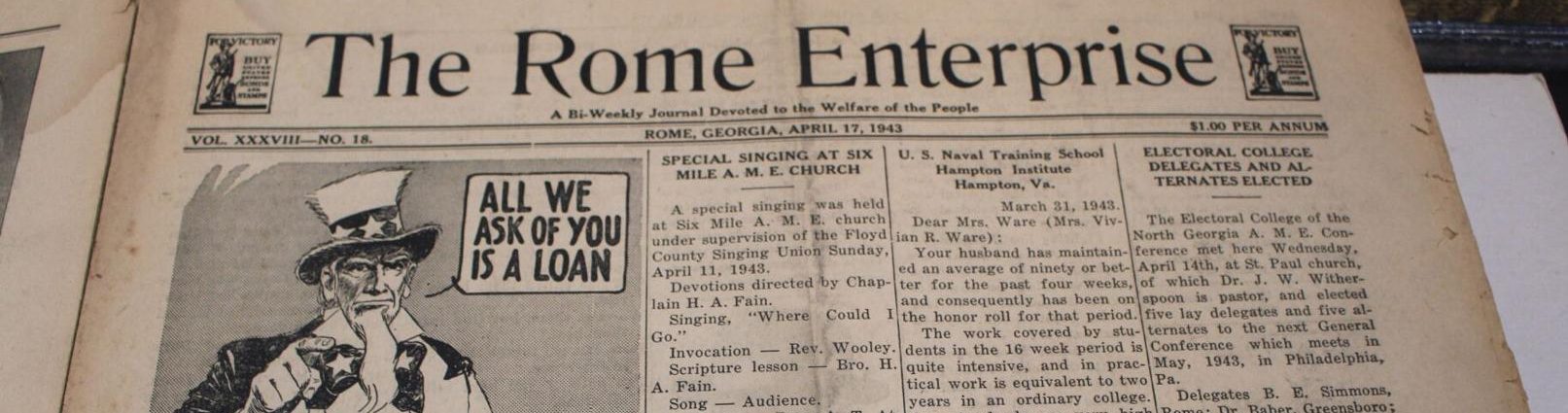
Around the same time, Carroll said that there is a large part of Rome’s black history that hasn’t been publicized or known enough: the city’s first black-owned newspaper.
“Deliverable number four is the story of the only black newspaper we’ve had in Rome, the Rome Enterprise, and its founding editor, Anak Atwater,” Carroll said. “[He] lived very close to Berry – on Branham – it’s not far at all from Myrtle Hill Cemetery where he and his wife are buried.”
The class’s fifth deliverable hinged on the fourth, to digitize 40 issues of the Rome Enterprise.
“To be definitive in telling the story of this newspaper, [which] meant digitizing the only known repository of these newspapers,” Carroll said. “That has not been a success. We have not found the cooperation that we feel like we need from the Rome Area History Center.”
Once the class understood the project’s “umbrella,” Carroll divided up the class to embark on these deliverables based on their curiosities and abilities.
“We subdivided according to interest,” Carroll said. “That interest could either be the subject or the medium. So, we knew the narratives would be written, because the nature of telling those stories demands text. But we also have a video tour of this area with all these projects in mind, so that people can see the sites that we know.”

Sunderhous said that her passion for telling people’s stories drew her into the forensic portion of the project.
“When we were assigning roles, we had to rank our skill sets,” Sunderhous said “I really enjoy research, so I kind of took over the role of researching and trying to find everything I could about the victims and about what happened.”
When the project took off, Sunderhous said most of her classes consisted of researching microfilm: film-esque reels that contain copies of Rome’s dated newspapers.
“Mainly, I was in charge of going through microfilm,” Sunderhous said. “Printing the old newspapers from the 1900s, and then basically giving that to the class [so] that they could write their own stories based on what we found.”
Wood gravitated to a completely different side of the project, leaning more toward his love of code and web design. He works with Berry Information Technology Students (BITS), saying his computer science passion along with BITS made the choice easy.
“I was tasked with getting the website back up and running,” Wood said. “Originally, I thought I was creating the website from scratch. I [thought], ‘Oh my goodness, I don’t know how I’m going to get that done in a semester.’”
Wood’s task was then set into motion as Carroll and Parker laid some solid groundwork for him.
“Thankfully, Carroll told me about Parker and how he had most of the assets already set up,” Wood said. “So, I went to talk with him, and I got the information.”
For Hudgens, her role followed similar tracks of Sunderhous’, but with a more individualized research focus.
“My role has been to cover the lynching of George Reede, which comes with a lot of history and reading a lot of [The] Rome News Tribune,” Hudgens said. “When you’re reporting about something to this degree, you have to be careful, making sure that it’s credible, and have the right sources.”
Sunderhous and Hudgens were assigned research on a heavy part of Rome’s history head-on. Carroll said this specific mission was to fill in journalistic holes about two of the city’s lynching victims.
“The vision at the start was back to ‘Murder 101’,” Carroll said. “To be able to break through and find better information on two of the four lynchings about which we know very little.”
Of the four, Sunderhous was assigned to conduct research on Walter Allen, who was lynched in 1902 right where the restaurant “El Zarappe” stands currently in Rome. Carroll wrote about Budd Rufus, who was hung on a railroad trestle in Coosa Valley, and Hudgens wrote about George Reede, who was killed beside a railroad. One victim is missing from this research.
“The victim of the fourth lynching, which would have been the first lynching to occur in Floyd County, is completely unnamed and unknown,” Sunderhous said. “If you look at any documentation of the lynchings in Floyd County, they’re just known as unnamed victim.”
Sunderhous found disappointment in the lack of information on this victim, out of sympathy for the individual’s humanity.
“That was the hardest part because I wanted so badly to get this person’s story and name out there because they deserve that,” Sunderhous said.
Secondary research has led Carroll’s class to new discoveries, deepening their understanding of primary knowledge.
“We know things, and as often happens, these become rabbit trails,” Carroll said. “The rabbit trail that starts with where Budd Rufus’ lynching was, [leading] to a microhistory of railroads in Northwest Georgia.”
While researching George Reede, Hudgens, along with the six other students, did secondary research. Hudgens explored history directly related to Reede’s death; The Rome and Decatur Railroad.
Hudgens said that research aided her in discovering more about Reede.
“That helped me connect both stories,” Hudgens said. “It’s not just me reporting on the lynchings, but George Reede was killed beside the [Rome and Decatur] railroad.”
Sunderhous found great pride in personifying each victim, making it her mission to give them more of a narrative.
“I wanted to find more than just that they were a victim of horrific racial violence,” Sunderhous said. “What more can I find on them that gives them more of a story than just this?”
As the class is reaching its final weeks, students like Wood said this opportunity wouldn’t have been possible without Carroll.
“Carroll was incredible during this class,” Wood said. “I mean, being able to help, but also not wanting to take over the project so much. He even made it feel not like his school project, necessarily. It [was] genuinely more like a work situation than a school classroom.
Sunderhous said it is important for the Berry populous to know about
these stories.
“It’s so worthwhile for people to educate themselves and read these articles, especially students at Berry,” Sunderhous said. “A lot of people walk around just completely out of the loop having no clue that any of this happened.”
Wood said that publicly releasing the class’s research will have a serious impact on the entirety of Northwest Georgia.
“[From] this class, we’re touching the Berry community, the “Berry Bubble”, and we’re touching the [city of] Rome as well,” Wood said. “If people know what the site is and if we can get this out, it’s going to impact the entire community of the entire town of Rome.”
Findings recorded in Carroll’s COM 323 will be publicly available on berrycollegestudentmedia.com under Viking Fusion beginning next year.
Even though the semester saw some drawbacks out of their control, Carroll believes there is great value in failing.
“Failure teaches all sorts of things,” Carroll said. “We’ve regarded everything we’ve done as learning. We learned a lot about how archives are administrated their priorities, learning all sorts of things we never even thought we might.”


Leave a Reply