

Chloe Coffield, staff writer
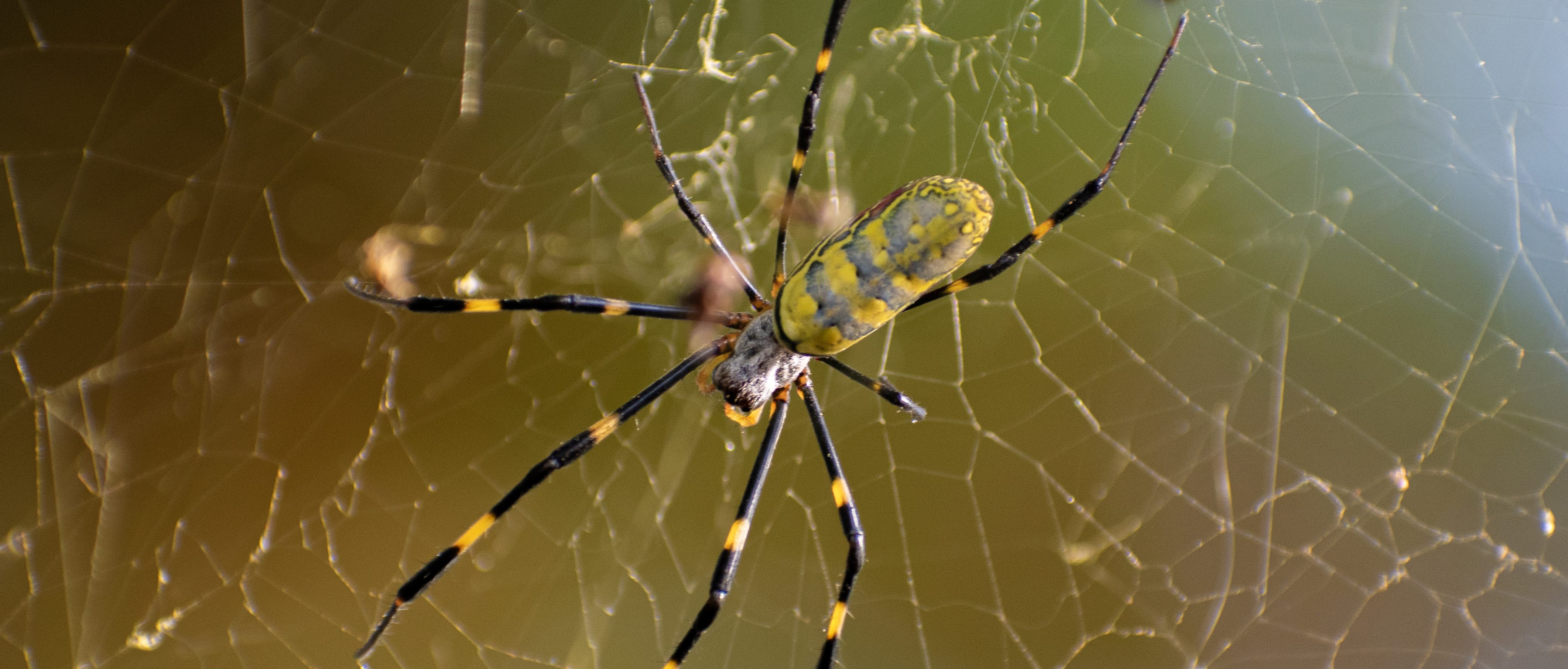
Known to have more of a prominent presence in the late summer and fall months, Joro spider populations have noticeably increased on Berry’s campus. Marked by bright yellow and blue or grey and green bands on their backs, Joro spiders differ in size and coloring with native orb weavers in Georgia.
These spiders might appear to be invasive upon finding them in almost every tree you find on campus, but according to Assistant Professor of Environmental Science Adrienne Ernst, there is more to the story about what it means to be classified as an invasive species.
“The definition of an invasive species is most commonly: a non-native species that has a negative impact on ecosystems,” Ernst said. “It can look a variety of different ways and is really dependent on the species, but we usually see that these invasive species are better at acquiring resources than our native
species are.”
Ethan Hague, a recent graduate of Berry with an undergraduate degree in environmental science, shares his connection to these spiders, as well as Ernst.
“I was a research assistant under Ernst while I was a student,” Hague said. “We would go up on the mountain to collect spiders for a project and it was interesting to see how high their large webs would stretch.”
Hague said he believes Joro spiders aren’t exactly invasive and actually control other invasive insect populations.
“The Joro spiders are really good at handling invasive species, such as brown marmorated stink bugs and spotted lanternflies, that come from that region,” Hague said. “The Joros will eat whatever shows up in their web, so they are definitely having an effect. I just wouldn’t go so far as to call them invasive.”
Ernst said there are varying opinions on when the spiders first made an appearance, but the method of their travel has been largely agreed upon by researchers.

“They are definitely not native, and have been expanding their range really rapidly. The first record of them in Georgia, depending on who you ask, is around 2013 or 2014. Now, they are as far north as Maryland,” Ernst said. “Joro spiders have this ability called ballooning. When you have a spiderling that’s just been hatched, they can do this neat trick where they will put out a bit of silk, then use it to carry them on the wind. This means they most likely hitched a ride in from something that got shipped here from Asia.”
Ernst said that there are studies that are being made to track their rapid spread.
“The University of Georgia has been doing some studies where they’ve looked at the diets of Joros and their findings suggest that the Joros are ‘overhyped’ as an invasive species,” Ernst said. “The Joros will hunt and catch things like stink bugs and other native creatures but they aren’t competing for the same food as native spiders.”
Closer to the ‘Berry Bubble’, their numbers appear to be getting more apparent on campus as the years go by, Ernst claims.
“One of my students did her honor thesis on spider diversity on campus,” Ernst said. “She compared the diversity we found on campus with iNaturalist, which is a community science platform where you scan a photo that has automatic identification software so you can see what spider you’re looking at. We found that, even just on the Berry campus, we have a lot more diversity than has been recorded on iNaturalist across Northwest Georgia and Northeast Alabama.”
Even since the 2013/2014 boom in Joros, they continue to spread throughout not only Georgia, but our college campus at Berry as well, Ernst claims.
“In the three years I’ve been working here, I’ve seen Joros become a lot more common,” Ernst said. “I used to see them primarily on roadsides and more disturbed areas, but now I’m noticing them in natural areas. I’ve seen them the worst along Victory Lake on campus.”
Hague said people on Berry’s campus are in no danger from the Joro spiders, but need to be aware of their presence.
“On campus there is a nice, robust network of biodiversity, especially spiders,” Hague said. “I definitely don’t see the rise of Joro spiders as anything of a threat. The spiders themselves feel most secure in their webs, so they won’t bite you unless you want them to bite you.”



Leave a Reply