

Dekira Wilkerson, staff writer
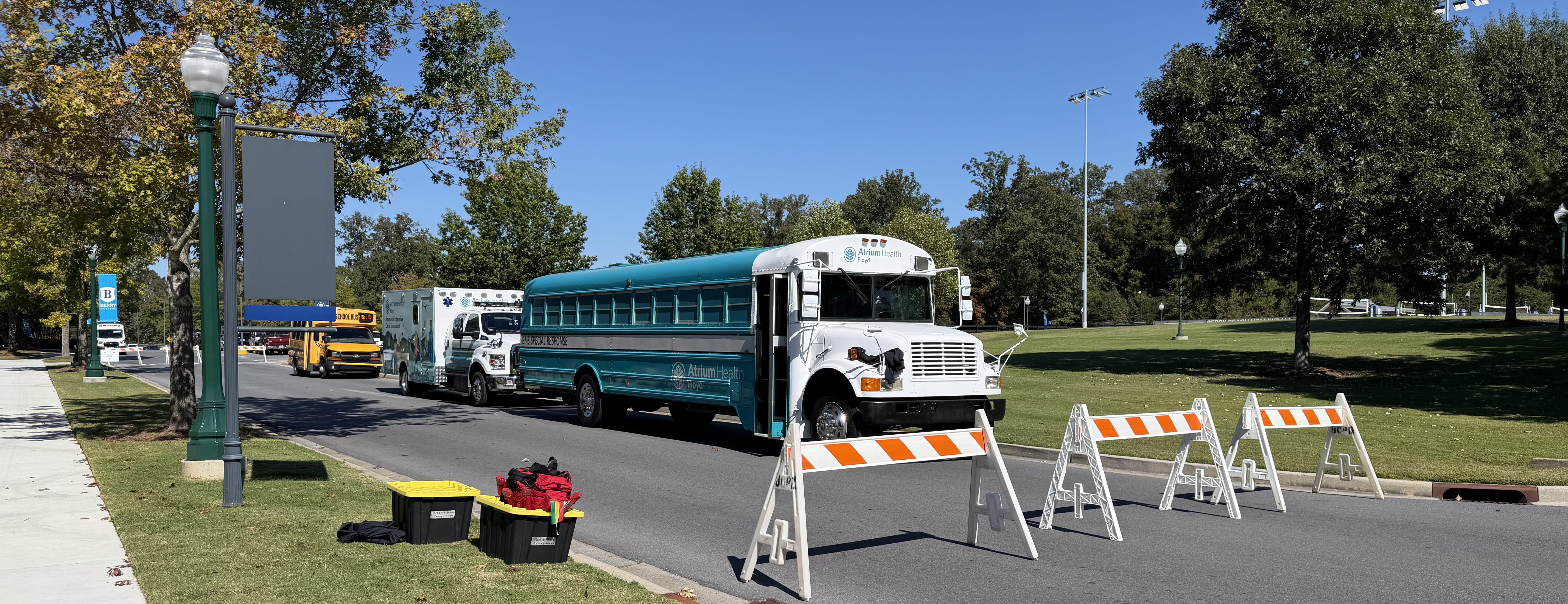
Berry College Nursing and Emergency Medical Services students responded to a simulated tornado disaster on campus on Oct. 23. The simulation tested their ability to triage patients, communicate with first responders and provide medical care in a realistic emergency scenario designed to prepare them for a career in healthcare.
Associate Professor and Nursing Disaster Simulation Co-Coordinator Danielle Gunter described the disaster simulation as a way to teach healthcare professionals and for Berry to meet accreditation standards for the nursing program.
“The disaster simulation is a learning experience for any kind of healthcare professional, but specifically this time we were focusing on our nursing students and some community paramedic EMS students,” Gunter said. “In this case, we were doing a weather-related simulation, where there’s some kind of injuries of multiple patients at one time.”
Senior nursing student Ashley Castaneda said the disaster simulators are beneficial for healthcare students because they give them confidence in handling crisis situations. She said playing out the scenarios allows them to practice their coursework more hands-on.
“Realistic simulations are vital because you truly never know when a disaster might strike near you or when you might need to respond,” Castaneda said. “Having hands-on knowledge and expertise in what to do during a crisis leads to much better outcomes because we know we can step up and provide aid.”
The simulation acted out what would happen if there were a tornado on campus while an athletic event was occurring. They pretended as though there were trapped and injured people outside of Valhalla. Castaneda described the experience as one of the nurses in the simulation. They had to divide the task into two phases, one being helping those on site and second being assisting the injured to a hospital setting.
“It was split into two parts,” Castaneda said. “First, aiding those directly on the scene and triage-tagging them based on injury severity. Second, stepping into specific nursing roles to respond to the injured in a hospital setting.”
Castaneda was placed in the Medical-Surgical unit. There, she and the students in her group used triage tags to code severity of injuries and track patients.
“I was instructed to work in a small group that included two other students and an EMT,” Castaneda said. “Together, we went to the impact scene, assessed the injured and applied the appropriate colored triage tags — green, yellow, red or black.”
Castaneda said after assessing the scene, she cared for the admitted patients while getting ready for patients.
“Afterward, we transitioned to specific hospital roles with our peers, where I provided ongoing inpatient care for admitted patients while simultaneously preparing for incoming disaster victims.”

Castaneda, having worked in a more intimate smaller group on scene and later working with a larger group at the simulation hospital, said that her cohort worked well together.
“We were originally paired with two to three students and later worked in larger groups of eight to 14 students,” Castaneda said. ”It was essential to communicate, remain calm and collaborate to provide our patients with the best possible care, which is exactly what
we did.”
The participants for the disaster simulation consisted of either nursing students who had taken the class and been a part of the simulation previously or students from Rome High School.
“Usually, our simulations are assigned to specific classes and all participants that were playing the role of the nurses were enrolled in that class,” Gunter said. “The students playing the role of the injured patients were mostly volunteers, either upperclassmen who had done it before or students from our local high school ”
The nursing program has always had these disaster simulations but for the last couple of years, instead of hosting their own, Berry has attended Georgia Highlands simulation. Due to a recent change in curriculum, Berry had decided to host their own simulation in the Morgan-Bailey area on campus.
“We have not hosted our own disaster drill in this capacity in several years, but since we changed the curriculum, we wanted to try to offer it ourselves here on campus,” Gunter said.


Leave a Reply