

Brian Jones, managing editor
Abhijit Naskar, author of the 2018 book “Time to Save Medicine” once said, “in action lies life, and with that action, history is made.” This past spring, the Berry community saw just that.
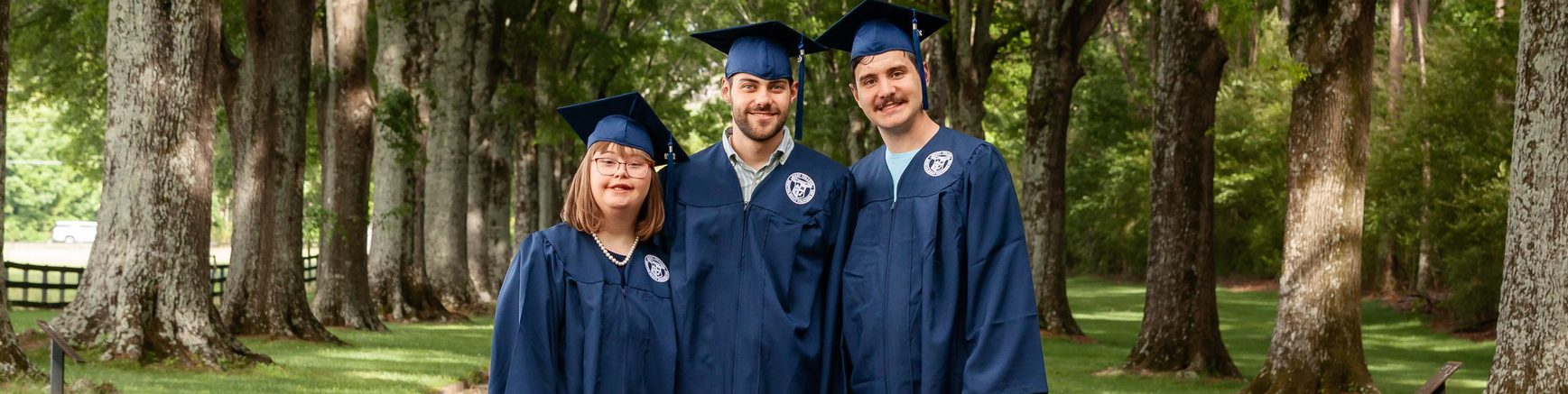
In April, Valhalla commenced its annual graduation ceremony. Breaking from the mold of tradition, Berry’s new Inclusive Post Secondary Education program (IPSE) saw their inaugural class of students walk across the stage for the very first time.
Berry’s IPSE is one of 10 in the state, also making history as the first private school in Georgia to have an IPSE program. The program lives in the Cook building.
IPSE is a program founded on the mission of bringing a two-year college experience to admitted students with intellectual disabilities. Students in the program are paired with peer mentors: student workers who teach and navigate their peers through several professional and life skills, including financial literacy and self-advocacy.
Two years before last spring’s historic moment, a vision emerged for the program in 2014, spearheaded by Director of IPSE Michelle Haney.
Haney said her interest in special education emerged from her work in public schools along with her upbringing.
“I grew up seeing people that had been institutionalized since they were babies,” Haney said. “And their whole lives, parents were told it was the right thing to do: to give up guardianship, [which] leads to lots of abuse.”
Along with this issue rocking Haney’s upbringing, the social problem of institutionalization is universal and widespread, with the intelectually disabled not recieving education laws until 1975.
Haney turned that fear into purpose, shaping the issue of institutionalization into her professional career.
“My career has been trying to figure out how to get people included in the community,” Haney said. “[To not be] segregated in settings that maybe were designed for good reason, but limited choices and opportunities.”
After obtaining her Ph.D. from Georgia State in 2000, Haney noticed that a program aiming to incorporate disabled students was no where to be found in Rome.

“When I first came to Berry, we didn’t have a program in special education,” Haney said. “There really wasn’t a lot of work being done on campus with this population.”
Through working with various non-profit organizations around the Rome-Floyd area, a program called Devoloping, Independence, Growth, and Support (DIGS) stuck out to her. Haney incorporated her psycology coursework with the organization. She said a parent planted the first seed of Berry’s IPSE.
“I was partnering with my classes and just trying to get engaged with them,” Haney said. “A mom, Karen Cook, said, ‘Have you heard about IPSE, where young adults of intellectual disabilities come to college and get to have a college experience?’”
A wave of confusion splashed onto Haney, discovering a new realm of inclusive education. Cook then issued Haney a plan of action: an investigation into what these programs looked like around Georgia.
“I felt really embarrassed,” Haney said. “I’m a school psychologist [and] never heard of that, She said, ‘You need to go to Kennesaw State (KSU), because they were the first one [to impliment an IPSE program] in the state, [and] you need to see what they’re doing.’ So, I took her up on it.”
Haney arrived at KSU’s graduation ceremony, seeing the school’s IPSE graduates walk across the stage. Leaving the ceremony, she was stunned that this program didn’t have a home at Berry.
“I was like, ‘Why are we not doing this at Berry College?’” Haney said. “This is our mission: to educate with the hands, the heart and the head.”
Haney wasted no time implementing this idea in Rome. She said that President Steve Briggs saw potential in the idea of an IPSE program on campus.
“I reached out to Briggs and explained the situation,” Haney said. “He said, ‘Well, let’s have a meeting,’” So, we all had a meeting, and he said, ‘Let’s do it.’”
From that meeting, the idea was converted into action. Haney said this is what got the ball rolling for the program.
“The idea of having people that historically had not been on a campus like this seemed more like a possibility,” Haney said.
In 2023, Haney soon realized that this project was too grand for just one person. She started recruiting, trying to locate an IPSE coordinator. She found interest in her former student Anne Bise (07C). Bise taught pre-K and educational support after obtaining her master’s degree in psychology, making her fit for the job.
Immediately, Bise said her and Haney started getting to work, contacting surrounding schools.
“I started reaching out to different IPSE programs in Georgia, talking to them,” Bise said. “‘What do you do here?’ ‘What do you do there?’ Trying to piece things together, we just kind of went for it.”
Before the program reached it’s advent, a crucial puzzle piece for IPSE came to frutiton.
The addition of peer mentors became the glue that connects IPSE with the Berry community, adding another layer to the program’s student experience.
“Our program provides, and not all programs are like this, a peer mentor as much as [IPSE students] need,” twice a week, “They meet with [a] student to, have quizzes. review readings. – it just depends on the student.”
From there, the central IPSE class was formed. Haney said that the class serves as a fundamental touchstone for their college experience.
From there, the central IPSE class was formed. Haney said that the class serves as a fundamental touchstone for their college experience.
“[In our] IPSE classes, [students are] almost completely with their Berry peers twice a week during that 11 to 12:00 hour,” Haney said. “It’s a lot like BCC 100 but spread out the whole year. Our students [also] take BCC 100, but we spend a lot of time on professional development.
Haney said the class is crucial for her students, providing an example of the many fundamental life skills students are taught.
“We teach self-advocacy, How do you explain to people and advocate for yourself when you need support? How do you navigate your social identity as a person with a disability?”
All three of last Spring’s graduates emerged from the class and program with direction, lighting a fire that has always been within them. Haney spoke about the inaugral cohort of students: Kate, Will and Griffin.
“In our first cohort, we had a student who was very interested in healthcare,” Haney said. “We had another student who was interested in farming and agriculture and then a student who wanted to do something with computers.”
Haney said how singular each student was, blessing the program with three unique perspectives.
“Those were our three students in day one,” Haney said. “[They] could not have been more different, just like a typical Berry Student.”
Everyone in the cohort had vibrant, inspiring journeys. The first student, Kate, had an initial career interest, but then pivoted.
“Kate was interested in healthcare, but that wasn’t where she ended up staying,” Haney said. “She also loved sports, making friends with the volleyball team and somehow finagled a job with sports medicine.”
medicine ended up getting her a volunteer position in Rome.
“She, right now, is volunteering at Atrium Health,” Haney said. “She’s doing some shadowing in some different areas in the hospital to see where she might end up. She loves getting to do that kind of work.”
IPSE students get the valuable opportunity to be involved in LifeWorks. For Will, he gained valuable experience through working with Berry Bees.


Leave a Reply