


Sydney Martinez, editor in chief and Roxanne Gasana, deputy news editor
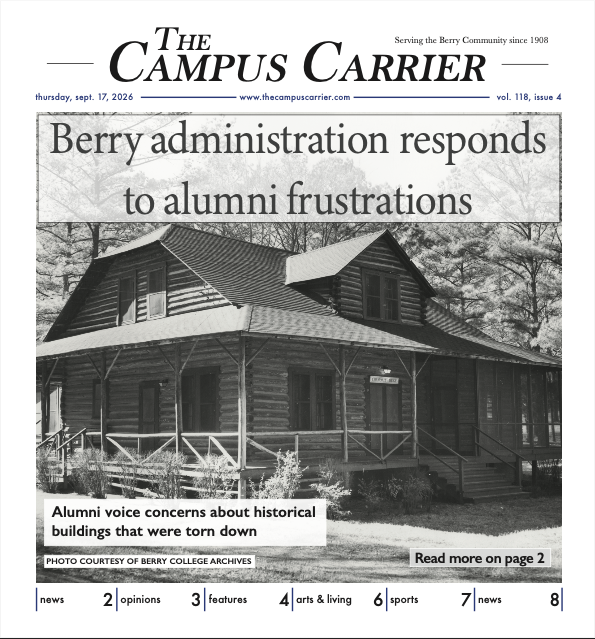
Pinewood Cottage and Cherokee Lodge, both believed to have been built in the 1920s, were demolished in March and May 2026, respectively. The college’s actions have sparked debate among alumni and preservation advocates about how Berry goes about making decisions regarding its historic buildings.
According to the Department of Archaeology and Historic Preservation, a structure over 50 years old can be registered as a historic building. Cherokee Lodge and Pinewood Cottage were registered as historic structures with the National Park Service.
Mark Cochran, Berry’s architect on retainer for approximately 10 years, worked on the Bell Recital Hall renovation project and collaborated with Jennifer Dickey (80C) — Berry’s previous historical preservationist — in restoring Barnwell Chapel. Both projects were completed in 2019 and have been nationally recognized for Berry’s preservation efforts.
Cochran conducted assessments of both Pinewood Cottage and Cherokee Lodge before he recommended the buildings to be torn down and rebuilt. His assessments included examining the buildings’ crawl spaces, attics, structural components, materials and indoor air quality.
According to Cochran, Cherokee Lodge had severe water damage, which led to deterioration of the exterior decorative logs, inner walls, floors and bricks. He explained that in the ‘90s, the lime mortar that had been holding the decorative logs in place had been removed and replaced with a sealant.
“I’m not sure if [the sealant] was polyurethane, but what it did not allow the logs to do is to weep out the water,” Cochran said. “The water sat in there a long time, and it would leak down into the building, so through years and years of water intrusion, the logs, the interior wall and the floor system rotted. The bricks also started to deteriorate, and the footings gave way to the soil.”
After his team’s assessments, Cochran said Cherokee Lodge could not have been historically restored.
“It was determined that the building was in such a state of disrepair that it wasn’t reasonable, in my opinion, to salvage it,” Cochran said.
Chief of Staff Casee Gilbert said some of the maintenance concerns could have been addressed earlier, but the problems with Cherokee went further than fixing gutters or other easily repairable issues. She said the foundation of Cherokee was the biggest issue when it came to assessing whether the building could be restored and repairing a foundation with damage that severe would have required taking much of the building apart.

“Over time, because [Cherokee] was a hundred-ish years old, the soil had shifted and there were some significant foundation issues with the building that was making it unsafe,” Gilbert said. “That was part of what [Cochran’s team] found during their assessment of the space. That’s not easy to fix. You cannot fix the foundation of a building without really taking the whole thing apart.”
Berry’s relationship with WinShape Foundation played a role in the future of Cherokee Lodge and Pinewood Cottage. WinShape leases parts of the Mountain Campus, including the land both buildings are on. Gilbert said the organization had previously used Cherokee and Pinewood for staff housing. WinShape has funded other projects on Mountain Campus, including renovations made to Normandy Barns. Because the Lodge and Cottage are on WinShape’s lease agreement, the organization is therefore responsible for funding the reconstruction of Cherokee and Pinewood.
“Those were two buildings that were part of that lease agreement for [WinShape] to use for their purposes,” Gilbert said. “When we identified that both Cherokee and Pinewood were in need of help, they are the ones that are going to be helping to fund those projects.”
Cochran said Pinewood Cottage had originally been built elsewhere but was later moved to Berry in pieces. He added that, like Cherokee, Pinewood had water intrusion, and its indoor air quality contributed to the decision that the building could not be saved.
“My philosophy with old buildings is it’s best just to go in and gut out from the inside,” Cochran said. “At that point in time, it was just determined due to air quality and life safety issues, in addition to the rot and some kind of structural instability in some places, that it was not feasible to save Pinewood either.”
The reconstruction plans for Cherokee incorporate key elements that were unique to the original buildings. The new Cherokee Lodge won’t be an exact replica, but the new design will integrate some of its distinctive features, including its unique roof.
“There was a particular type of roof on Cherokee called a jerkinhead roof that we reincorporated into the new design,” Cochran said.
Pinewood will follow the original building’s design more closely. Cochran said measurements of the footprint and floor plan taken from the original building are going to be used in the new reconstruction plans. The only addition is going to be an enclosed porch to prevent animals from making homes under the building.
“The original intent was to try to lay out and keep the building,” Cochran said. “When it was determined that the house wasn’t salvageable, the floor plan wasn’t abandoned.”
Materials from the original Cottage will also be reused. Cochran said rock that was added to Pinewood when it was moved onto campus will be salvaged. In addition to the rock, wood from a cedar tree removed near the building would be incorporated into the new building.
“We had to remove a cedar tree,” Cochran said. “We’re reusing that cedar tree to craft a cross that’s going in the interior of the home.”
On the other hand, Cherokee had barely any materials that could be reclaimed from the original building.
“Cherokee was in such poor condition that very little of anything was reasonably salvageable,” Cochran said.
Jennifer Dickey, an alumna and Berry’s former preservation consultant for nearly 20 years, was hired as Berry’s consultant under Steve Briggs — Berry’s previous president — to give advice on how to preserve historic buildings on campus. Jennifer Dickey had previously warned administrators about Cherokee Lodge’s conditions and concerns involving water damage.
“I’d been telling them for a long time, you need to do some work on Cherokee,” Jennifer Dickey said. “After one of the downspouts fell off the gutter, it was just pouring down and causing one of the outer walls to collapse. I told them it was a critical situation out there.”
Even after this, she said she was not consulted about Cherokee or Pinewood before they were torn down.
“I was not informed beforehand that Cherokee would be demolished and learned about the demolition after visiting Mountain Campus,” Jennifer Dickey said.
Her sister, Angela Dickey, also an alumna, was with her when they discovered the building was gone.
“It was shocking,” Angela Dickey said. “We both started crying, and we just couldn’t believe it.”
As a result of the demolition, Angela Dickey organized a petition raising concerns about Berry’s preservation and lack of communication. She said her petition initially received 66 signatures but was later signed by more than 130 people.
“I sent the first draft to Jason Sweat of the Alumni Council and Jennifer Knight of the Daughters of Berry on June 15 with 66 people on it,” Angela Dickey said. “When I sent the petition in again, I had 132 or 133 people on it.”
A petition on Change.org was created on June 18 to reach a wider network of Berry alumni, students and supporters. The petition closed with a total of 1,138 signatures.
A graduate of the class of 2014 and supporter of the Change.org petition, left a note, signed Aaron, stating the demolition of the buildings on Mountain campus doesn’t sit right with him.
“As a graduate of the class of 2014 and a son of two Berry alumni, the appearance of lack of care for the historic buildings on campus deeply disturbs me and saddens me,” Aaron said. “The entire appeal of Berry has often been its historic roots and adherence to the ideals of Martha Berry, and I fear that is being lost amongst the administration in both its lack of care and its disregard for continued usage of buildings.”
Gilbert acknowledged that there could have been more communication between administration and alumni regarding their plans for the building. Communication was made with WinShape, but not alumni.
“If I could apologize for one part in all of this as it relates to Cherokee and Pinewood, I wish that we had communicated better,” Gilbert said. “We didn’t, and we know that. We will do better moving forward.”
Because Cherokee and Pinewood were not being used as student housing at the time, the college did not see the demolition as something that would affect the students’ daily lives.

“To be perfectly honest, those two spaces aren’t super impactful with student experience,” Gilbert said. “[Students] weren’t living in them. Many [students] may not have been able to find them on a map. So, I think that was part of our, not necessarily our rational, but it wasn’t a campus announcement, because it was happening at a period of time when most [students] weren’t here, and it wasn’t impacting [students’] day-to-day.”
Recent graduate Blake Howard (25C) became involved with the preservation efforts on campus. He worked at Oak Hill as a historic preservation assistant throughout his time at Berry and participated in Alumni Work Week projects involving historic buildings.
He believes routine maintenance is one of the most important issues in protecting Berry’s historic buildings. He referenced Barnwell Chapel as a building that required significant restoration after years of deterioration.
“Routine maintenance can prevent some historic buildings from reaching the point where major restoration becomes necessary,” Howard said. “Historic buildings that are not regularly used by students still have value as part of Berry’s history. Buildings like Roosevelt Cottage, the Cottage in the Pines, Martha Berry’s office in the Hoge Building, the Old Mill and Possum Trot need to be cared for.”
For Howard and other alumni, the question is not only about whether a building is currently being used by students but whether its historic significance should be a factor when making decisions about its future.
“You have to maintain these buildings. You can’t just let them go and then say, well, they’re too far gone to save,” Jennifer Dickey said. “It seems to me that what the school has adopted is a philosophy of demolition by neglect, and frankly, demolition of neglect is about as high a crime you can commit in the preservation world.”
Gilbert said Berry faces a similar tug-of-war between maintaining its history and providing resources that meet current students’ needs.
“I think that is the tension that we are constantly holding,” Gilbert said. “What do we need as it relates to facilities for current operations, departments and academic programs for students, faculty and staff? And then how do we do that but still maintain the legacy, the history and the specialness of our campus?”
The debate extends beyond Cherokee and Pinewood, because Louise Hall — the oldest building on Berry’s Log Cottage Campus — is also being considered for demolition and reconstruction.
“Berry originally planned to renovate the building and even began fundraising for the repairs, but they later determined that they can’t restore Louise Hall,” Jennifer Dickey said.
The reconstruction plan for Louise Hall would retain its historic character while bringing the building up to current building codes and making it accessible for students.
For the Dickeys and many alumni, however, historic buildings remain an important part of Berry’s identity and provide a physical connection to the college’s past.
“My family has been connected to Berry for nearly a century, and I attended Berry nursery school before graduating from both the academy and the college,” Angela Dickey said. “We grew up at Berry, so Berry was like our third parent.”
Jennifer Dickey described her approach to preservation as “smart change, informed change” and argued that historic buildings can be adapted while retaining important historic features.
“I’m not trying to stop change from happening,” Jennifer Dickey said. “I’m trying to make sure that we have smart change, informed change and change that pays attention to the historic fabric of our campus.”
Howard furthered this point, emphasizing that preservation can sometimes be preferable for the environment compared to demolition and new construction.
“Preservation is a lot to manage because Berry has over 150 buildings on over 27,000 acres, but we still need to try at the end of the day,” Howard said. “Oftentimes the most environmentally friendly thing to do is to preserve a building rather than demolish one and create a new one.”
President Sandeep Mazumder expressed his gratitude towards Berry alumni who are deeply engaged and passionate for the college. He said a small amount of alumni voiced their concerns about Cherokee Lodge and Pinewood Cottage, stating that if they had known the reasoning behind the building’s demolition, they would have agreed with college administration.
“I would argue that most alumni, if not all alumni, if they know the full context of the situation, they would agree with the choices we’ve made,” Mazumder said. “I think some of the vocal alumni probably did not understand the full context behind these decisions, and the college leadership team and the Board of Trustees, we have that full and complete institutional picture when we’re making these decisions of what our students need now and in the future.”
Mazumder said there are a multitude of factors that go into deciding what buildings are renovated, restored or torn down. From the Americans with Disabilities Act to budgeting, sustainability is the administration’s top concern.
“There’s a myriad of factors that arguably some of the discontent alumni were just not thinking about in the same way we would think about them,” Mazumder said. “The truth is, all of that goes into these decisions, and maybe that wasn’t fully understood.”
Mazumder said he wants alumni and students to trust in the administration. He said not one decision about the college is taken lightly.
“Trust the leadership team and board,” Mazumder said. “We are taking all these factors into consideration, and we don’t make these big decisions in a light weight. We know that these are big, important decisions for the college, and immense thought goes into them and they’re not done haphazardly. While maybe it can come across as that to some, that’s not the truth.”
Gilbert said that decisions about historic buildings are important to the administration, and the top priority is balancing current needs with preservation.
“Berry continues to assess its buildings individually rather than applying one approach to every historic structure,” Gilbert said. “We make tough choices and decisions, and sometimes that means that we aren’t able to save everything.”
As Berry moves forward with reconstruction plans for Cherokee Lodge and Pinewood Cottage, the debate raises a broader question about how the college will preserve its buildings’ history while updating the campus to meet the needs of current and future students.
“You can change historic buildings,” Jennifer Dickey said. “You can adapt them. But you have to do it in a way that respects what they are and what they mean.”



Leave a Reply