

Jenna Bacon, Campus Carrier arts and living editor
Ali Luciani, Campus Carrier asst. arts and living editor
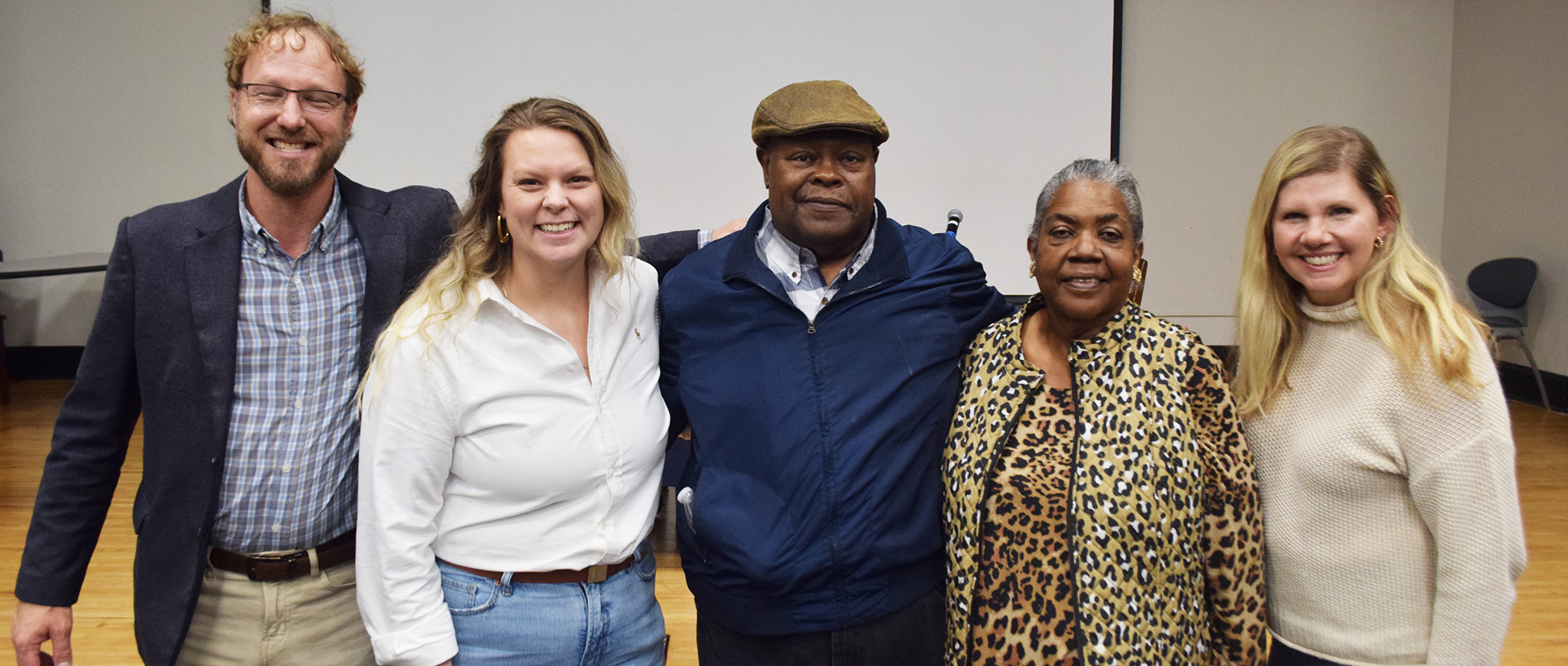
Associate Professor of Environmental Studies and Anthropology Brian Campbell and Assistant Professor of Communication Margaret Ndwandwe hosted a film screening on Thursday for the documentary film “Her Name Was Hester.”
The film followed Stacie Marshall, a woman who had just inherited her family’s 200-year-old farm in Summerville, and the journey she embarked on after discovering a document confirming that her great-great-great-grandfather had purchased seven enslaved people.
The initial decision to film Marshall was inspired by one of Campbell’s students
in 2015.
“She wanted to make a film, and so we developed the idea for a feminist movie about that woman, Stacie Marshall, moving back to her family farm,” Campbell said.
According to Marshall, the first part of the project focused on her life as a seventh-generation farmer and one of the first women to take ownership of the farm.
“In that process, I discovered the slave registry and was just very sobered by that,” Marshall said. “I began to want to do more work around finding the descendants of the people that my family had enslaved, and so the documentary really took a turn.”
At this point, Campbell took over the film due to the sensitive nature of the conversations that would be recorded but kept students as assistants on the project.
Marshall spoke with Campbell after finding the registry. She said her next step was moving back to the farm, reconnecting with the community and trying to find Hester’s descendants.
“I remember talking to Dr. Campbell and saying, ‘Listen, this just happened,’” Marshall said. “And I really think the next step for me is moving back to the farm and reconnecting with the community and figuring out if there’s a way I can find this family.”

Campbell encouraged Marshall to speak to her Black neighbors about what she had found and her desire to pursue reconciliation and historical reparation. With permission from Marshall and her neighbors, Campbell was able to film some of those interactions.
One part of the film shows Marshall telling her close family friends, Betty and Melvin Mosely, about the registry she had found. The document didn’t list the names of the slaves, but it included two men, a woman and four children under the age of six.
“I went to a neighbor because they were spiritual mentors of mine, and then Dr. Campbell was filming that interaction,” Marshall said. “And that was the Mosley family.”
Marshall goes on to say that her grandfather had told her stories about the enslaved woman. Her name was Hester, and she was a wet nurse. Then the conversation in the film shifted to generational curses and how people can work to break them.
For Marshall, the project quickly became more meaningful than just showing her life on the farm.
“It was so much more than a documentary because it was like this very living story unfolding as we were filming,” Marshall said.
The film captures Marshall navigating the difficult balance of acknowledging her family’s past and taking responsibility without being consumed by guilt.
“But I think grief looks like ‘This was a horrible thing that was done,’” Marshall said. “I cannot undo it, but what is within my agency? What do I have agency over?”
Marshall worked alongside research historian Virginia Bolton to continue the search for Hester’s descendants. One of the film’s most remarkable moments was when Marshall sat the Mosley family down to tell them that Betty Mosley was, in fact, a descendant of Hester.
“Miss Betty said, ‘Oh, you’ll never find them. They’re probably all dead,’” Marshall said. “Not knowing she was one of them.”

Betty Mosley shared her perspective on this revelation, noting the importance of long-standing relationships.
“Relationship is everything,” Betty Mosley said. “We’ve known Stacy and her dad now for a long, long time, when you know people for a long time, long time, you got a relationship with them. I loved Stacy before I found out about it, and I love her still after we done found out about it.”
For both Marshall and Betty Mosley, the documentary became a platform to confront systematic issues while emphasizing personal growth and community. The first time Marshall spoke publicly about her family’s past was in one of Campbell’s classes. Marshall described how she felt in that moment.
“I was just shaking,” Marshall said. “It was a very needed experience for me because I think my family had distanced themselves from the history, along with many white Southerners. You know, as the generations go past, we distance ourselves from this history. And what happened in that distance has forfeited other families the right to their own family history. That is just wrong.”
Mosley said that faith and love are essential in healing generational wounds.
“You know, the only thing that can conquer hate is love,” Mosley said. “I try to love people. People can have their different views and we might not never come to an agreement.”
“Her Name Was Hester” is one of four films in the “Stories of Repair” series. A screening of the next film, “Seeing the South,” will take place on March 26. March 26 at 6:00 P.M. in the Evans Auditorium


Leave a Reply